
Forge Project is a Native-led nonprofit organization whose mandate is to cultivate and advance Indigenous leadership in arts and culture. In 2021, Other Means designed the visual identity and a custom typeface for the emerging organization, based on the main building on their 60-acre campus in Upstate New York.
Architecture and Place
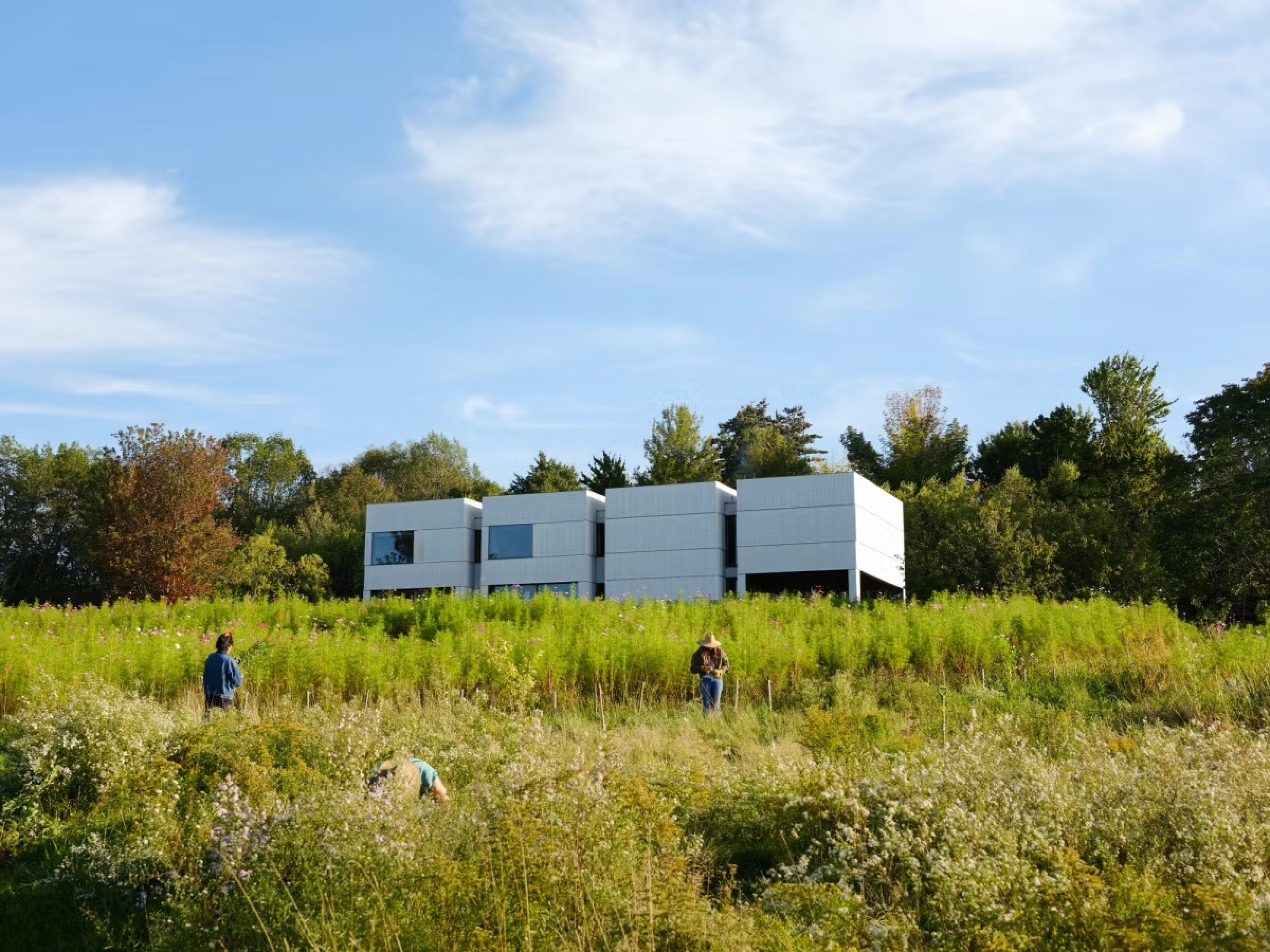
The main building on Forge Project’s 60-acre campus was designed by Ai Weiwei, initially to serve as an art-forward residential home. The space currently serves as a meeting place and gallery for selections from Forge’s permanent collection. The building consists of four equal-sized boxes, built as simple wood construction covered with corrugated metal panels.
Forge Project’s visual identity is built on a custom typeface drawn from the gridded facade of its main building, with each letter formed from rectangular modules.

Logo and Typeface
The contrast created by something so angular and geometric in the surrounding green space exemplifies the nature of Forge’s mission, its collection, and its fellows, while reckoning with the ancestry of its land.
FORGE

Neue Haas Grotesk

Panama

Neue Haas Grotesk and Panama complement Forge’s typeface. Used together, they allow information to shift in tone and emphasis without relying on a fixed logic.
Forging Journal
Forging is the editorial branch of the Forge Project. The digital-first publication is dedicated to critically imagining Native futures in the form of feature-length news reportage, long-form cultural analysis, visual essays or written interviews.
Built from the same underlying logic as the angular Forge typeface, Forging replaces its straight lines and hard corners with curves. The two are clearly related, while giving the journal a softer and more editorial voice.
Color
The Forge color palette refuses restraint in a collection of saturated tones that are paired together, applied in layers and used liberally across platforms.
Auburn #81331D

Yellow #F7D447

Cloudy Sky #EAFFEC

Neon Green #DCFF00

Dark Green #2B653C

Dark Blue #003BB8

Pink #FFCAC9

Burnt Orange #C45500

Blue #2970FF

Purple #6E5CC3

Bright Yellow #FFF200

Turquoise #07F7F3

Sea Foam #70C4CD

Grass Green #00CC44

Dark Grey #3A3D36

Soil #755400

Forge Project’s color palette follows the approach of Indigenous artist Jeffrey Gibson, who resists the long-standing tendency of institutions to render Indigenous art in neutral, earthy tones that relegate it to the past. In Gibson’s abstract, geometric compositions, vibrant, saturated color is central.


Forge extends this ethic through a palette that mixes saturated neons with warmer neutrals and muted cool tones, designed to operate in relation rather than hierarchy. Images are often rendered in duotones, layering vibrant colors on top of one another. Nothing is meant to recede; color exists everywhere without moderation.
Form and Shapes
A loose vocabulary of geometric forms extends throughout the identity, drawing on the angular shapes and repeated patterns found across a range of Indigenous visual traditions. Used as frames and containers, the forms shift in scale and composition from one application to the next. Rather than forming a fixed system, they provide another variable element within the identity, being layered with type and color to build compositions that can be dense, irregular, or spare.


Website
The primary application of the Forge Project identity is its website, a digital space for the organization to announce upcoming programming, host its growing collection of Indigenous art and digitally publish editorial content.
Land Acknowledgement
To enter the Forge website, one is required to accept the Terms and Conditions of a Land Acknowledgement.
Malleable Headers
Forge’s custom typeface is designed to be vertically or horizontally distorted to fit within its designated space. Each section of the website demonstrates this when the menu is unveiled, compressing the type below.
The Collection
As of early 2025, Forge’s collection comprises over 180 contemporary works. The entire collection is available to browse on the website, filterable by decade, medium or artist.
Toolkit
The modular, interactive shapes used throughout the website—most prominently on the Toolkit page—function as a kind of bulletin board where they are used to announce new events and initiatives, share ideas, and surface helpful resources.
Applications


